Companion Reference for “Who Pays for Idaho Power’s New Plants?”
Companion Reference for “Who Pays for Idaho Power’s New Plants?”
The following content is provided to help you understand the compromise that is HB 911. It is not part of the article, but it does provide context. I have also included a short glossary.
This reference contains:
HB 911’s Journey
HB 911 Comparison with Earlier Legislation
Glossary of Terms
HB 911’s Journey
The following four bills were introduced during the 2025 and 2026 Idaho legislative sessions to address electricity demand from large industrial customers and protect existing ratepayers.
House Bill 395 (2025): A Good Bill That Died in the Senate State Affairs Committee
Title: Competitive Procurement and Ratepayer Protection
Status: Passed the House 62-8 on March 26, 2025. Died in the Senate State Affairs Committee.
Introduced: March 10, 2025
Effective date: None. Did not become law.
What it proposed:
Originally established a 10-megawatt threshold, subsequently amended to 30 megawatts.
Required large-load customers to bear the costs associated with their additional electricity requirements.
Provided opportunities for competitive procurement of electricity from third-party suppliers.
Sought to prevent additional generation costs from being passed on to existing ratepayers.
Official legislative record: https://legislature.idaho.gov/sessioninfo/2025/legislation/H0395/
House Bill 756 (2026): Another Good Bill That Died in the House State Affairs Committee
Title: New Large Loads, Ratepayer Protection and Cost Responsibility
Introduced: February 24, 2026
Status: Died in the House State Affairs Committee.
Proposed effective date: July 1, 2026.
Actual effective date: None.
What it proposed:
Established a 20-megawatt threshold within five years.
Required a full no-harm test.
Prohibited rate increases attributable to new large loads for existing customer classes.
Required minimum billing provisions, exit fees and financial security.
Required consideration of incremental infrastructure costs and financial risks.
Exempted certain existing facilities whose electricity demand exceeded 50 megawatts as of January 1, 2000.
Official legislative record: https://legislature.idaho.gov/sessioninfo/2026/legislation/H0756/
Senate Bill 1368 (2026): Yet Another Good Bill That Died in the Senate State Affairs Committee
Title: New Large Load and Ratepayer Protection
Introduced: March 4, 2026
Status: Died in the Senate State Affairs Committee.
Proposed effective date: July 1, 2026.
Actual effective date: None.
What it proposed:
Established a 30-megawatt threshold within 36 months.
Required Commission approval of new large-load electricity contracts.
Established a 180-day deadline for contract approval or denial.
Required large customers to fund their share of additional electrical infrastructure.
Required protection against customer default.
Largely codified existing utility regulatory practices.
Official legislative record: https://legislature.idaho.gov/sessioninfo/2026/legislation/S1368/
House Bill 911 (2026): The Compromised Bill We Got
Title: New Large Load and Ratepayer Protection
Effective date: July 1, 2026
Status: Enacted into law
Session Law: Chapter 335
Idaho Code: § 61-335
House passage: March 20, 2026 (65-3)
Senate passage: March 30, 2026 (34-1)
Signed by governor: April 10, 2026
What is included in HB 911:
A 50-megawatt threshold within a 60-month period.
Applicability to qualifying service contracts entered into on or after July 1, 2026.
Commission approval of qualifying electricity contracts before service begins.
A 270-day deadline for contract approval or denial.
Full cost-of-service requirements for new large-load customers.
Financial security against abandoned projects and stranded investments.
A mandatory no-harm assessment.
Protections against artificially splitting electrical loads to evade the law.
Contract cost recovery reviews during general rate cases.
“Reasonable assurance” that existing customers’ rates will not increase because of new large loads.
Official legislative record: https://legislature.idaho.gov/sessioninfo/2026/legislation/H0911/
HB 911 Comparison with Earlier Legislation
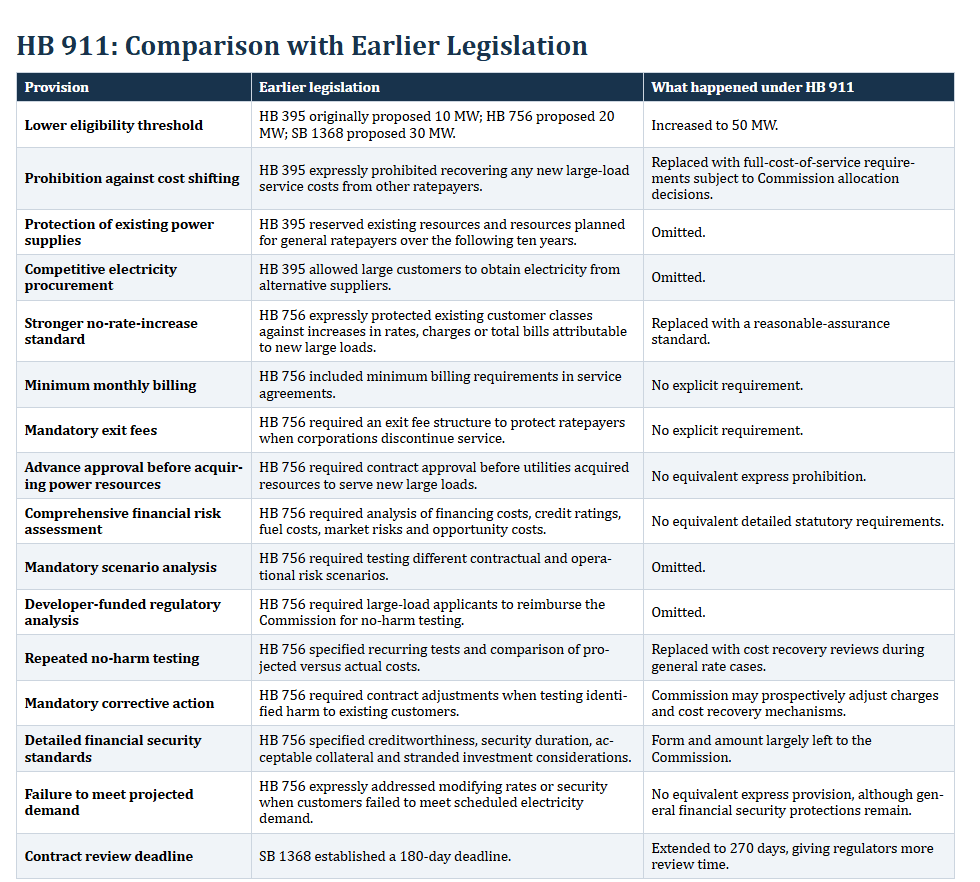
Glossary of Terms
AED (Average and Excess Demand): A cost-allocation formula based on average electricity demand and demand above that average during peak periods.
AED-4CP (Average and Excess Demand with Four Coincident Peaks): A version of AED that considers customer demand during four system peak periods.
Cost Allocation: The method used to determine how electricity system costs are divided among different customer groups.
Cost Shifting: Transferring costs attributable to one customer or customer group onto others.
Customer Class: A category of electricity customers, such as residential, commercial, industrial or irrigation users.
EFAC (Energy and Fixed Cost Allocation Classification): A method of classifying electricity system costs according to their fixed-cost and energy-related characteristics.
Exit Fees: Charges imposed when customers terminate contracts early, intended to cover unrecovered infrastructure investments.
Full Cost of Service: All costs attributable to providing electricity service to a customer.
General Rate Case (GRC): A regulatory proceeding that determines how much revenue a utility may recover and how electricity rates are established.
Generation: The production of electricity.
GRM (Growth Responsibility Method): Idaho Power’s proposed method of allocating certain generation and transmission costs based on customer-class demand and energy growth.
Hourly-Informed Method (Hourly formula): A cost-allocation method that considers when customers use electricity throughout the year.
Intervenor: An organization or party formally authorized to participate in a regulatory proceeding.
IPUC (Idaho Public Utilities Commission): The state agency responsible for regulating Idaho Power’s rates and service.
Megawatt (MW): A measurement of electrical power equal to one million watts.
Minimum Billing: A contractual requirement to pay a minimum amount regardless of actual electricity usage.
No-Harm Assessment: An evaluation of whether serving a new large customer would financially harm existing ratepayers.
NLL (New Large Load): A new or expanding customer with substantial electricity demand.
PAEM (Peak and Average Embedded Method): Idaho Power’s proposed methodology for classifying existing generation costs using peak and average system demand.
Peak Demand: The highest electricity demand during a specified period.
Ratepayer: A utility customer who pays for electricity service.
Revenue Requirement: The total revenue a regulated utility is authorized to recover to cover approved costs and earn an allowed return.
Special Contract: An individually negotiated electricity service agreement, typically for a large industrial customer.
Stranded Investment: Infrastructure investment whose costs cannot be fully recovered because anticipated demand or revenue fails to materialize.
Transmission: The movement of electricity over high-voltage power lines.
Transmission Capacity: The amount of electrical power a transmission system can reliably carry.
Sources
- Originally published on Substack: https://jeffapierson.substack.com/p/companion-reference-for-who-pays