Technocracy Threatens Idaho
How forgotten ideas about God, man, and stewardship shaped today’s energy and data crisis.
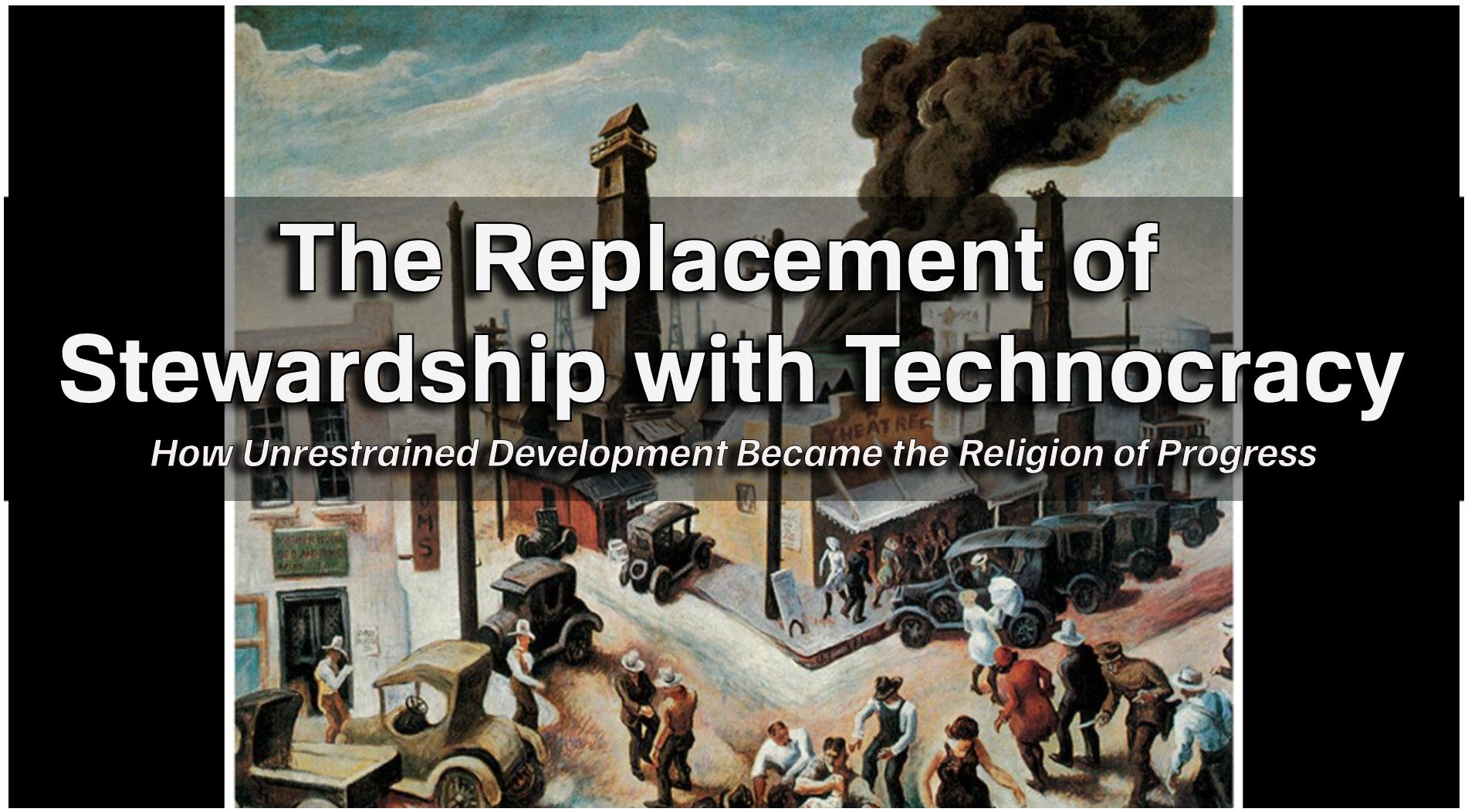
“These are the two factors that lead to the destruction of our environment: money and time, or to say it another way, greed and haste. The question is, or seems to be, are we going to have an immediate profit and an immediate saving of time, or are we going to do what we really should do as God’s children?”
Pollution and the Death of Man (1970) by Francis A. Schaeffer
The Roots of Progress Without Conscience
The modern world builds faster than it thinks. Cities stretch beyond their limits, farmland disappears, and rivers are turned into conduits for power. Governments and corporations call it progress, but something essential is missing.
That emptiness did not begin with technology or economics. It began with ideas.
Centuries ago, Humanism and Higher Criticism changed how people understood God, truth, and the world itself. Humanism taught that man, not God, is the measure of all things. Higher Criticism, born in the universities of Europe, treated the Bible as literature rather than revelation. Together they replaced stewardship, the care of what belongs to God, with confidence in human reason and progress as ultimate guides.
Once that shift occurred, progress stopped being moral and became mathematical. Instead of asking whether something is good, society began asking whether it can be done and whether it will make money. Economists and engineers replaced pastors and families as the voices of authority. The duty to care for creation became a technical problem for experts to solve, not a moral calling to answer.
The Rise of Technocracy
That mindset gave birth to technocracy, a world ruled by data, efficiency, and control rather than by conscience or community judgment.
The results are visible everywhere. Cities expand until farmland vanishes. Highways, wind farms, and transmission corridors cut through ground held by families for generations. Rivers are dammed, diverted, and traded for power credits. The losses are justified with metrics: jobs created, megawatts produced, or revenue gained. The numbers look impressive, but they hide the cost, displaced families, lost quiet, polluted water, and broken trust.
Consider the oil boomtowns that rise overnight and fall just as fast, or the vast data centers that consume whole aquifers to cool their servers. Each follows the same creed: if it can be engineered, it should be built. Idaho’s energy corridors, Nevada’s lithium mines, and Arizona’s housing tracts all grow under that same philosophy.
The moral question “Should we?” has been replaced by the technical one “Can we?”
This is not progress. It is moral blindness.
When experts and investors manage growth without humility, both land and people become variables in an equation. Local culture and peace of mind are treated as side effects. Human reason and science are not evil, but when they rule without reverence, they lose sight of purpose.
Restoring Stewardship
Real stewardship is not anti-progress. It simply means remembering that land, community, and future generations are more than numbers. True leadership asks not just what can be built, but what should endure.
A healthy community measures success not in quarterly profits but in stability, fairness, and belonging.
Humanism taught that we could master the world. It forgot to remind us that we must answer for what we do with it. Progress without conscience builds quickly but builds poorly. It leaves behind noise, loss, and regret. The choice before every modern society is the same: build as masters of matter, or build as caretakers of creation. One leaves monuments. The other leaves a home.
Bonus History and Art: Thomas Hart Benton’s Boom Town
A Painter of the American Soul
Thomas Hart Benton, one of the most distinctly American artists of the twentieth century, understood this conflict long before the age of data and AI. Born in 1889 in Neosho, Missouri, he grew up between two worlds: the rugged democracy of the Midwest and the refined, European-influenced art scene of the East. His father served in Congress and his great-uncle in the Senate, and from them he inherited the belief that art should serve the people, not the powerful.
Benton’s nationalism was grounded in work, virtue, and community. He believed the spirit of America lived in its ordinary citizens, farmers, craftsmen, mothers, and laborers, not in its elites. He rejected the sterile intellectualism of European modernism, arguing that abstraction and academic art robbed creativity of meaning. His murals and canvases celebrated the labor and dignity of working people.
For Benton, the nation was not an ideology but a covenant among free citizens bound by moral responsibility.
A Moral Populist
Politically, Benton supported the early New Deal, believing it could restore dignity to ordinary Americans. But he distrusted both corporate monopolies and federal centralization, seeing each as a threat to self-government. His populism was moral, not partisan. He sought to defend the common man from systems that turned people into instruments of profit or policy.
If Benton lived today, he would stand with those who define conservatism by stewardship, virtue, and local accountability, not wealth or power. He would see in today’s battles over energy, technology, and community the same fight he painted: progress unmoored from conscience. His patriotism was not about control or conquest but about belonging, craftsmanship, and the rooted life of a people in harmony with their land.
The Story of Boom Town
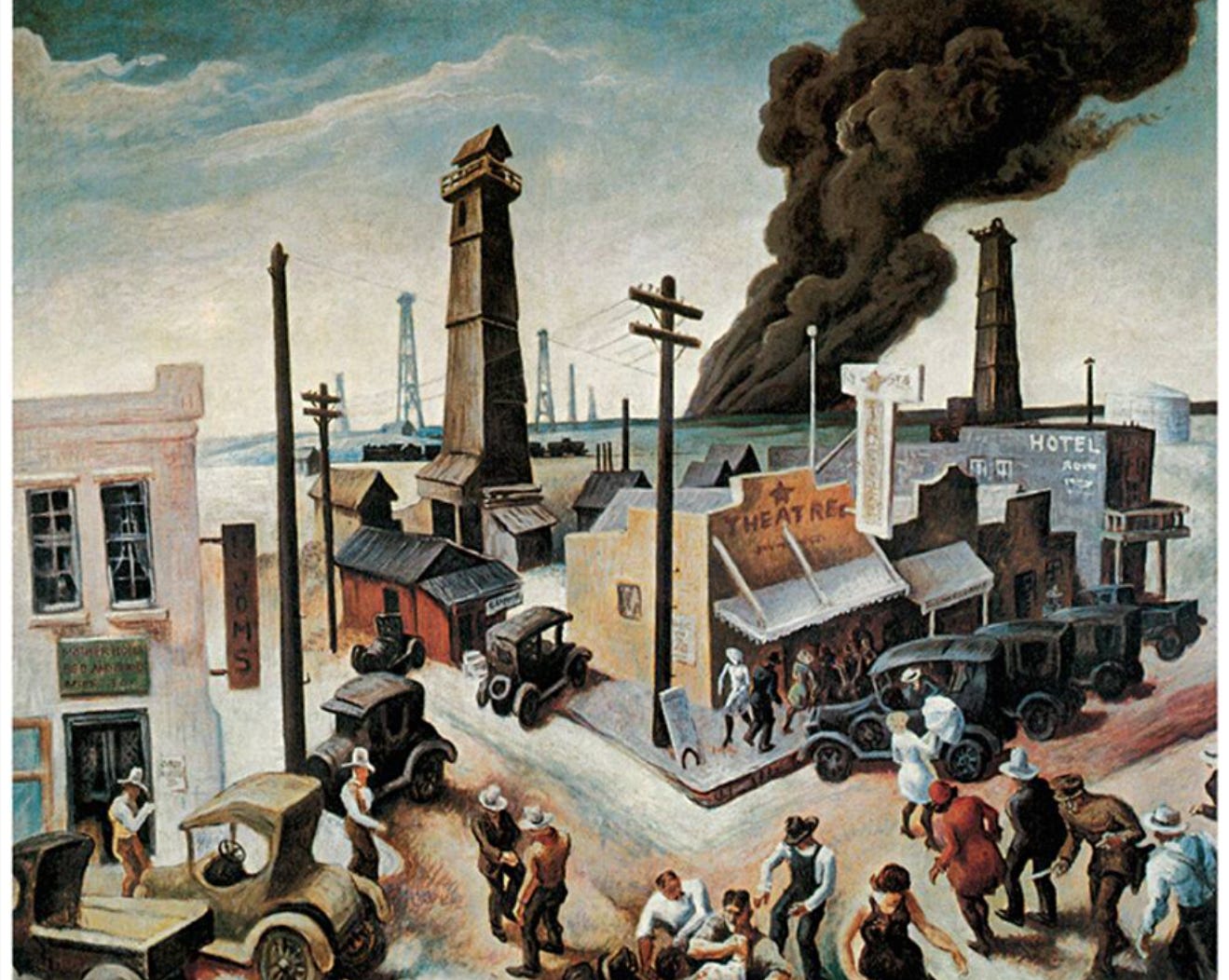
Benton’s 1928 painting Boom Town captures this conviction in paint. Inspired by the oil rush of Oklahoma and Texas, he depicted workers laboring under a swirling, violent sky as oil rigs pierced the horizon. The scene is alive with motion but devoid of peace. Every figure strains. Every line bends under tension.
Boom Town is not just about oil. It is about the cost of progress without restraint. Benton saw the oil fields as a mirror of America’s growing obsession with speed, expansion, and control, what he called “the mania of progress without roots.” The same ambition that built the derricks consumed the landscape and the people. Wealth came first, waste followed, and ruin was never far behind.
One year after Benton finished Boom Town, the stock market collapsed. His painting had become prophecy.
Through storm and tension, Benton showed that unrestrained progress is both triumph and tragedy. He believed a nation that forgets its land, people, and limits cannot endure. His art stands as a warning. The American dream without moral restraint becomes feverish and self-destructive.
The Lesson
A civilization must remember what it is for, not just what it can do. Technology, economy, and expansion are tools, not ends. When they cease to serve human dignity and begin to consume it, they become idols.
Benton’s lesson still applies. The health of a nation depends not on its machinery or wealth, but on the character of its people and the integrity of their relationship to the land.
References
Adams, H. (1989). Thomas Hart Benton: An American original. Alfred A.
Knopf.Baigell, M. (1982). Thomas Hart Benton’s regionalist vision. American Art Journal, 14(3), 28–45.
Benton, T. H. (1951). An artist in America (Rev. ed.). Rinehart & Company.
Burroughs, A. (1930, April). The boom towns of America: Benton’s warning in paint. The Art Digest.
Ellul, J. (1964). The technological society. Vintage Books.
Postman, N. (1992). Technopoly: The surrender of culture to technology. Alfred A. Knopf.
Shapiro, M. E. (1991). Thomas Hart Benton and the American scene, 1920–1945. Abbeville Press.
Smithsonian American Art Museum. (n.d.). Boom Town [Oil on canvas, 1928].
Sources
- Originally published on Substack: https://jeffapierson.substack.com/p/the-replacement-of-stewardship-with