The Fight for Jerome County
How a citizen's reform package is challenging Idaho's energy gold rush — and why every rural county should be paying attention

In the spring of 2026, while Idaho legislators debated tax exemptions for Big Tech and data center developers quietly optioned farmland across the Magic Valley, Jerome County residents did something almost no one does anymore: they read the county’s entire zoning ordinance, compared it against federal definitions, and surveyed their neighbors.
In 2026, Idaho lawmakers introduced House Bill 897, originally drafted to sunset tax exemptions for large-scale developments such as data centers and other high-capital projects.
The bill passed the House, signaling broad agreement that existing incentives were too open-ended. However, after being sent to the Senate, the bill failed to advance out of committee. Legislators reported significant industry pressure to weaken or block the measure. As a result, the proposed sunset of exemptions was never enacted, and the existing incentive structure remains in place. Senate leadership chose to favor out-of-state financial interests over reforms aimed at limiting long-term tax exemptions in Idaho.
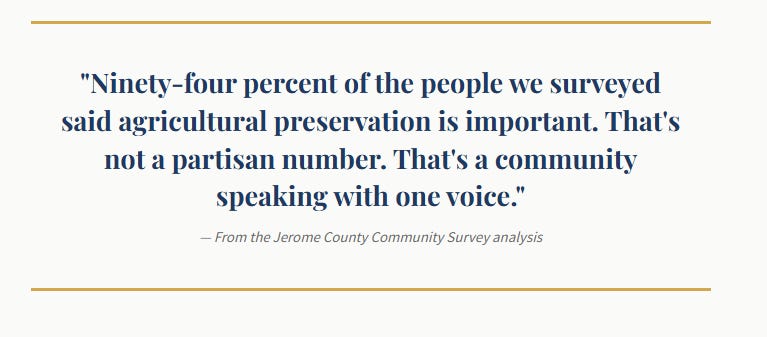
The result is the Jerome County Citizen’s Energy Ordinance Reform Package, a 200+ page citizen submittal that may be one of the most comprehensive local energy policy proposals ever assembled by a private citizen(s) in Idaho. It covers everything from three-tier energy facility classifications to decommissioning bonds, from aquifer protection to constitutional property rights, from the data center investment bubble to battery energy storage safety, baseload priorities to farmland preservation — and it’s backed by a community survey where 93.7% of respondents said they oppose large-scale energy facilities in agricultural zones.
This isn’t an abstract policy debate. It’s a fight over whether the county that feeds Idaho and the nation gets turned into a power plant for Silicon Valley.
The Problem Nobody Wanted to Talk About
Jerome County’s existing zoning ordinance, like those of many rural Idaho counties, was written for a world that no longer exists. Energy facilities — including industrial-scale solar arrays, wind farms, battery storage systems, and data centers consuming hundreds of megawatts — were either undefined or loosely regulated. In Jerome County’s case, energy projects were permitted in any zone, including prime agricultural land.
This wasn’t an oversight. It was an invitation.
The same features that make the Magic Valley one of the most productive agricultural regions on earth — flat terrain, cheap land, abundant water, and reliable electricity — also make it irresistible to the data center and energy industries. When the Jerome County Planning and Zoning Commission released its draft recommendations in February 2026, Pierson saw what he calls a “regulatory vacuum” — incomplete definitions, missing protections, and critical gaps between federal standards and local implementation.

What’s in the Package
The Citizen’s Energy Ordinance Reform Package is structured in a deliberate reading order, beginning with the policy foundation and moving through implementation, evidence, and reference materials. At its core are three proposed ordinance chapters — revisions to Chapter 10 (Utilities, within the Comprehensive Plan), Chapter 11 (Energy Facilities), and Chapter 7 (Conditional Use) — that together create a complete regulatory framework the county currently lacks.
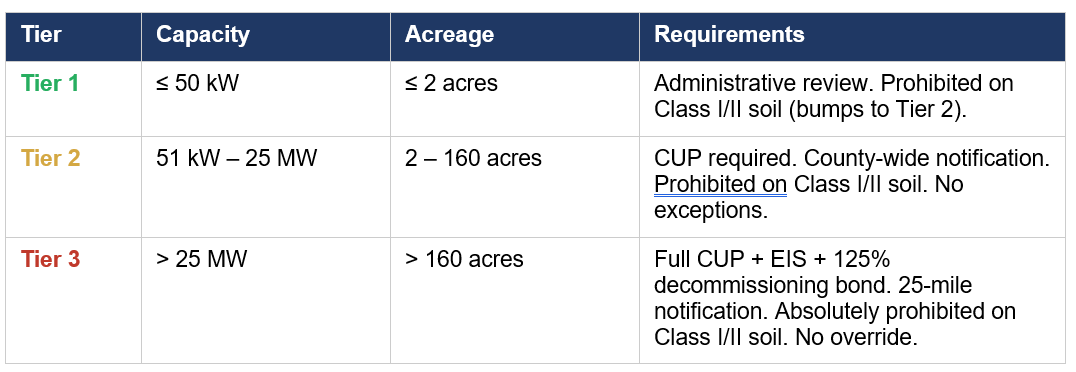
The keystone of the framework is a three-tier energy classification system aligned with federal definitions and Idaho state code:
Beyond the ordinance chapters, the Ordinance Reform Package includes a detailed response to the P&Z Commission's own recommendations — a line-by-line rebuttal identifying where the Commission's draft fell short — plus a position paper on property rights and community notification, a legal and ethical justification grounded in constitutional case law from Euclid v. Ambler to Nollan v. California Coastal Commission, a data center crisis paper documenting the $700 billion AI infrastructure bubble, a water resources supplement analyzing the Eastern Snake Plain Aquifer's 75,300 acre-foot shortfall, the complete community survey results, a glossary of definitions, and a comprehensive sources document spanning federal agencies, peer-reviewed research, state legislation, and constitutional law.
Idaho’s County-by-County Patchwork
Jerome County is far from alone in grappling with these questions — but it is among the few trying to answer them comprehensively. Across Idaho, a patchwork of reactions is emerging that ranges from outright bans to regulatory paralysis.
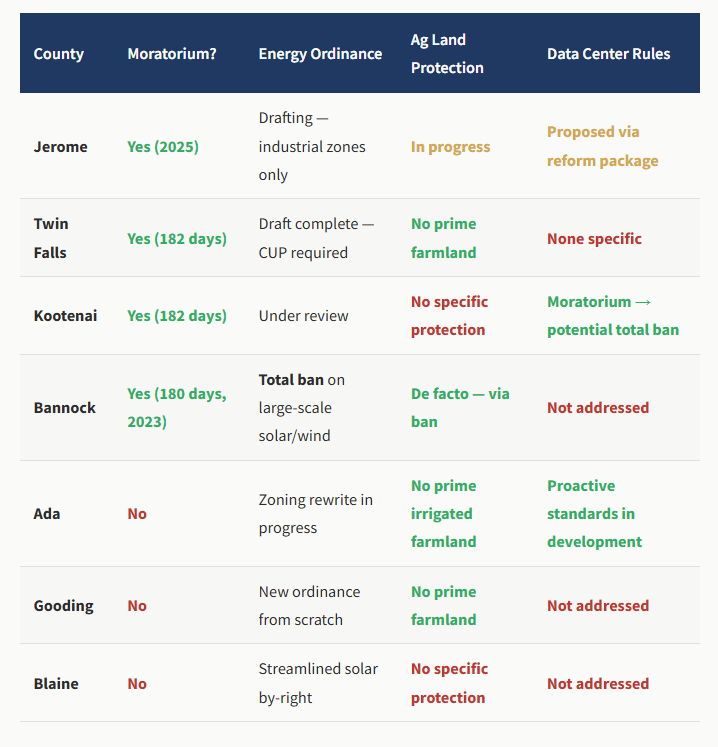
What's striking about this comparison is how much the Ordinance Reform Package addresses that other counties have left on the table. Twin Falls County's draft, for example, requires conditional use permits and protects prime farmland — but its notification radius is only 300 feet and it has no data center provisions. Kootenai County imposed a moratorium and is considering an outright ban, but hasn't proposed a tiered framework that would allow responsible small-scale development. Bannock County's total ban is the bluntest instrument of all — effective at blocking large projects but offering no pathway for community-scale energy that residents might actually want.
The Water Nobody Talks About
Perhaps the most urgent dimension of the Ordinance Reform Package is its treatment of water. The Eastern Snake Plain Aquifer — the lifeblood of southern Idaho agriculture — is already running a 75,300 acre-foot annual shortfall. Every new data center, every industrial cooling system, every large-scale energy facility that draws on this resource pushes the deficit further.
The numbers are sobering. A single large data center can consume between 500,000 and 5 million gallons of water per day for cooling. Idaho’s HB 895, which passed the House in March 2026, would prohibit new data centers from using groundwater for cooling — but only for facilities that begin construction after July 1, 2026. Facilities already permitted or under construction are grandfathered in.
Meanwhile, Idaho Power’s own 20-year plan projects a 50% to 75% capacity increase will be needed to service new large loads — and the rate increases to fund that expansion are already hitting residential ratepayers. The utility’s 2025 rate case resulted in a 7.48% average increase, with the original proposal calling for 17% on residential customers alone. The Gemstone Technology Park data center near Kuna is expected to consume 600 to 800 megawatts — roughly 20% of Idaho Power’s entire current generation capacity — by itself.
The Ordinance Reform Package ’s proposed solution is straightforward: define data center facilities as any operation consuming 1 MW or more of electrical load or 100,000 gallons per day of water, subject them to Tier 3 review requirements, and require comprehensive water impact assessments before any permit is issued. Battery Energy Storage Systems (BESS) would be prohibited in all agricultural zones due to fire and contamination risks.

The Bubble Question
One of the most provocative sections of the Ordinance Reform Package is its data center crisis position paper, which argues that the current AI-driven data center boom has the structural characteristics of a speculative bubble. Citing Goldman Sachs research, Yale School of Management analysis, and Brookings Institution studies, the paper identifies six classic bubble indicators present in the current market: exponential capital deployment ($700 billion globally), revenue uncertainty, overcapacity risk, historical pattern matching, cost externalization to local communities, and stranded asset potential.
The implications for Jerome County are concrete: if the bubble deflates, communities that rezoned agricultural land for data center development would be left with decommissioned industrial facilities, degraded farmland, depleted aquifer capacity, and rate increases that can’t be unwound. The Ordinance Reform Package argues that this risk alone justifies requiring full decommissioning bonds — set at 125% of restoration costs — before any permit is issued.
What Makes This Package Different
The Ordinance Reform Package stands apart from other county efforts in several ways. It doesn’t simply say “no” to energy development — it creates a tiered framework where small-scale projects can proceed with minimal friction while large industrial facilities face the scrutiny their impacts deserve. It doesn’t rely on moratoriums as a permanent solution — it proposes permanent ordinance language. And it doesn’t ask the county to take the author’s word for anything — it backs every claim with federal sources, peer-reviewed research, state legislation, constitutional case law, and direct community survey data.
About the Author's Disclaimer: "How you choose to view, review, and/or implement these recommendations is obviously out of my control. I am not looking for any credit now or in the future for this submission; my name is attached only for accountability and transparency."
The package also includes Idaho’s 2026 House Concurrent Resolution 032, the state’s energy sovereignty resolution affirming Idaho’s right to determine its own energy future — a resolution that strengthens the legal foundation for local zoning authority over energy facilities.
The Road Ahead
Whether Jerome County’s commissioners adopt the Ordinance Reform Package wholesale, cherry-pick its strongest provisions, or file it away and hope the problem solves itself remains to be seen. But the package’s existence changes the terms of the debate. It is now part of the official public record — submitted to the P&Z Commission, the Board of Commissioners, the County Clerk, and the Idaho State Archives. It cannot be ignored without a conscious choice to ignore it.
And that may be its most important contribution. In a political climate where energy companies spend millions on lobbyists and public relations campaigns, a single citizen with twenty years of technology experience, a clear understanding of the stakes, and the willingness to do the work has produced a document that is, by any measure, more thorough than what most county governments manage to produce with paid staff and consultants.
The question now isn’t whether the Ordinance Reform Package is good enough. The question is whether Jerome County’s leaders are willing to match the effort of the citizens they serve.
Audio:
In the spring of 2026, Idaho legislators debated tax exemptions for Big Tech and data center developers.
While those debates unfolded, Big Tech set its sights on farmland across the Magic Valley.
At the same time, Jerome County residents did something most people never do. They read the county’s entire zoning ordinance, compared it against federal definitions and other county ordinances, and then surveyed their neighbors.
The result was the Jerome County Citizen’s Energy Ordinance Reform Package.
It is a 200-plus-page citizen submission, one of the most comprehensive local energy policy proposals ever assembled by a private citizen in Idaho.
It covers everything from three-tier energy facility classifications to decommissioning bonds, from aquifer protection to constitutional property rights, from the data center investment bubble to battery energy storage safety.
It also establishes baseload energy priorities and creates transparent, objective standards designed to protect Jerome County from lawsuits by developers.
Most importantly, the reform package firmly preserves farmland, restricts the use of limited water resources, and limits, as much as possible, development on public lands and impacts to the viewshed.
The package is backed by a community survey, where 93.7 percent of respondents said they oppose large-scale energy facilities in agricultural zones.
This is not an abstract policy debate. It is a fight over whether the county that feeds Idaho and the nation is turned into a power plant for Silicon Valley.
Sources
- Originally published on Substack: https://jeffapierson.substack.com/p/the-fight-for-jerome-county